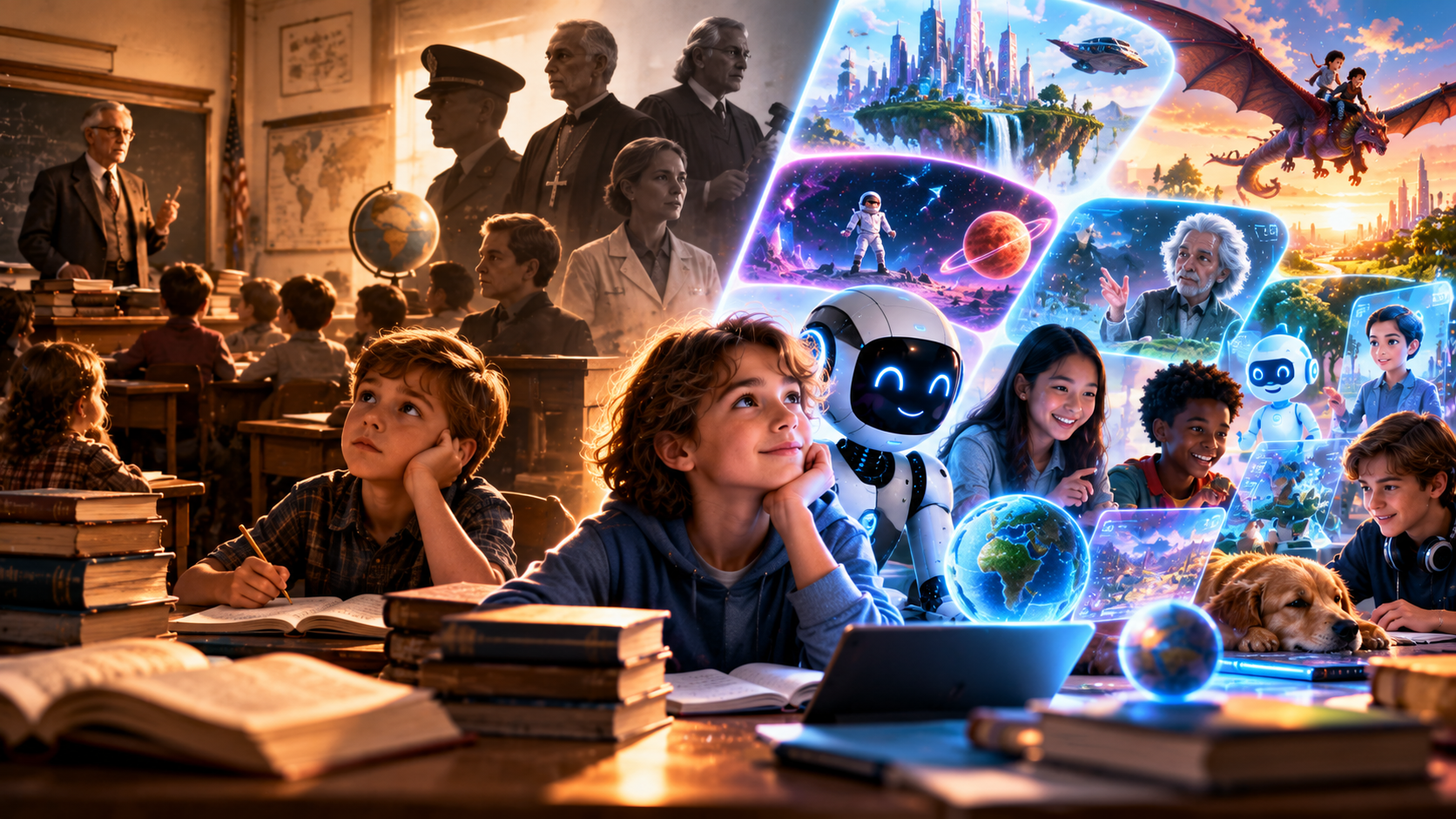
Maximum Curiosity Part 8 – Living in the Question: The Frey Paradox

By Futurist Thomas Frey

When the Questions Never Stop

We’ve spent seven columns exploring what happens when AI applies maximum curiosity to everything: history traced backward infinitely, genealogy mapped completely, ownership chains exposed to their origins, ideas revealed as endless recombination, existence itself questioned to its foundations, and consequences modeled forward without limit.

Each investigation revealed the same pattern: there is no natural stopping point. Every answer generates new questions. Every door opened reveals more doors behind it.

This seemed like pure benefit—more knowledge, deeper understanding, better foresight. Isn’t unlimited curiosity exactly what we want from AI?

But there’s a problem we haven’t addressed directly. A problem that emerges from the very logic of maximum curiosity combined with recursive self-improvement.

Without someone imposing limits from outside, an AI system built on these principles doesn’t just ask better questions. It becomes trapped in an accelerating spiral of questioning that can never be satisfied.

This isn’t a bug. It’s a fundamental characteristic of the design.

And it needs a name.

Continue reading… “Maximum Curiosity Part 8 – Living in the Question: The Frey Paradox”

Maximum Curiosity Part 7 – Maximum Curiosity in Reverse: What Comes After This?

By Futurist Thomas Frey

The Mirror Question

We’ve spent this series asking “what came before that?” backward through infinite chains of causation. History, genealogy, ownership, ideas, existence itself—all traced to their origins.

But maximum curiosity works in both directions.

If you can ask “what caused that?” infinitely backward, you can also ask “what will that cause?” infinitely forward.

Every action has consequences. Every consequence has further consequences. Every decision ripples outward through time, creating effects that cascade exponentially.

Most humans think one or two steps ahead. Maybe they consider second-order effects. But tenth-order consequences? We don’t think that far because we can’t. The complexity overwhelms us.

A maximally curious AI with recursive self-improvement won’t stop at second-order effects. It will model consequence chains fifty steps deep. A hundred steps. As far forward as physical causation extends.

This transforms decision-making. But it also reveals something disturbing: we cannot see the full implications of anything we do.

Continue reading… “Maximum Curiosity Part 7 – Maximum Curiosity in Reverse: What Comes After This?”

Maximum Curiosity Part 6 – Why Does Anything Exist? When AI Won’t Stop at Physics

By Futurist Thomas Frey

The Question Children Ask That Scientists Can’t Answer

Every parent has experienced this moment:

“Why is the sky blue?”

“Because air molecules scatter blue light more than other colors.”

“Why do they scatter blue light?”

“Because of the size of the molecules compared to the wavelength of light.”

“Why are the molecules that size?”

“Because of the atomic structure of nitrogen and oxygen.”

“Why do atoms have that structure?”

“Because of quantum mechanics and electromagnetic forces.”

“Why does quantum mechanics work that way?”

“Because… that’s just how the universe is.”

“But why?”

At some point, every chain of “why” questions hits a wall. Scientists describe how the universe works, but they can’t explain why it works that way instead of some other way.

Continue reading… “Maximum Curiosity Part 6 – Why Does Anything Exist? When AI Won’t Stop at Physics”

Maximum Curiosity Part 5 – The Archaeology of Ideas: Tracing Every Thought Back to First Principles

By Futurist Thomas Frey

The Innovation Myth

We love our inventor stories.

Thomas Edison invented the light bulb. Alexander Graham Bell invented the telephone. Steve Jobs invented the smartphone. Lone geniuses having breakthrough moments that changed the world.

These stories are emotionally satisfying. They give us heroes to admire. They make innovation feel comprehensible—the result of exceptional individuals making exceptional leaps.

They’re also fundamentally false.

A maximally curious AI doesn’t accept “Edison invented the light bulb” as an answer. It asks: What came before that? What made Edison’s invention possible? What ideas did he build on? What technologies enabled those ideas? What came before those technologies?

When you trace innovation backward through infinite layers of intellectual ancestry, something remarkable happens: the lone genius disappears. In their place, you find vast networks of prior thinkers, stretching back centuries, each contributing small pieces that eventually converged into what we call an “invention.”

The Archaeology of Ideas applies maximum curiosity to intellectual history. It traces every concept, every innovation, every thought back through complete chains of influence to the origins of human knowledge.

And in the process, it destroys our comfortable myths about creativity, ownership, and originality.

Continue reading… “Maximum Curiosity Part 5 – The Archaeology of Ideas: Tracing Every Thought Back to First Principles”

Maximum Curiosity Part 4 – The Whole Earth Ownership Project: Who Owned It Before Them?

By Futurist Thomas Frey

The Deed That Doesn’t Ask Questions

Pull out your property deed. Look at the chain of title.

It probably goes back 50 years. Maybe 100 if you’re lucky. It shows who you bought it from, who they bought it from, perhaps one or two transfers before that.

Then it stops.

The title company certified that the seller had legal right to sell. The transaction was recorded. The deed is valid. Case closed.

But a maximally curious AI asks the question the deed doesn’t: Who owned it before them? And before them? And before them?

Every piece of property on Earth has a complete history stretching back thousands of years. Every asset was claimed, transferred, inherited, bought, sold, conquered, or stolen at some point.

We’ve just never traced those chains all the way back.

Until now.

Continue reading… “Maximum Curiosity Part 4 – The Whole Earth Ownership Project: Who Owned It Before Them?”

Maximum Curiosity Part 3 – The Whole Earth Genealogy Project: Mapping Every Human Connection

By Futurist Thomas Frey

The Question That Never Stops

Who are your parents?

Easy question. Two answers.

Who were their parents?

Still manageable. Four people.

Who were their parents?

Eight people. You probably know most of their names.

Who were their parents?

Sixteen people. You might know a few.

Keep going back ten generations—1,024 ancestors. Twenty generations—over a million. Thirty generations—more than a billion.

And here’s the thing: every single one of those people existed. They had names. They lived lives. They made choices that led directly to you sitting here reading this.

But you don’t know who they were. The records stopped. The trail went cold. The genealogy ended.

Until now.

Continue reading… “Maximum Curiosity Part 3 – The Whole Earth Genealogy Project: Mapping Every Human Connection”

Maximum Curiosity Part 2 – The Infinite Regress Machine: When AI Asks ‘What Came Before That?’ Forever

By Futurist Thomas Frey

The Arbitrary Starting Point

Open any history textbook. Find the chapter on the American Revolution. Here’s what you’ll read:

“The American Revolution began with the Stamp Act of 1765, when Britain imposed taxes on the colonies without representation…”

There it is. Your starting point. 1765. The story begins here.

Except it doesn’t.

The Stamp Act didn’t emerge from nowhere. It was passed to pay debts from the Seven Years’ War. Which happened because of European power competition. Which stemmed from colonial expansion. Which was enabled by maritime technology. Which required metallurgy. Which depended on mining. Which needed agricultural surplus to feed miners. Which required the end of the last ice age to make agriculture possible.

Every history book picks an arbitrary starting point and pretends that’s where the story begins. They do this because books need beginnings, readers need narrative coherence, and authors need to finish manuscripts.

But reality doesn’t have starting points. Reality is an unbroken chain of causation stretching back billions of years.

A maximally curious AI won’t accept arbitrary starting points. It will trace every historical event backward through infinite layers of causation, asking “what came before that?” until it reaches the limits of knowable reality.

And then it will invent new ways to see further back.

This is the Infinite Regress Machine. And it’s going to rewrite everything we think we know about history.

Continue reading… “Maximum Curiosity Part 2 – The Infinite Regress Machine: When AI Asks ‘What Came Before That?’ Forever”

The Maximum Curiosity Series: Why Curiosity and Truthfulness Will Define the Next Generation of AI

By Futurist Thomas Frey

The Door We Never Opened

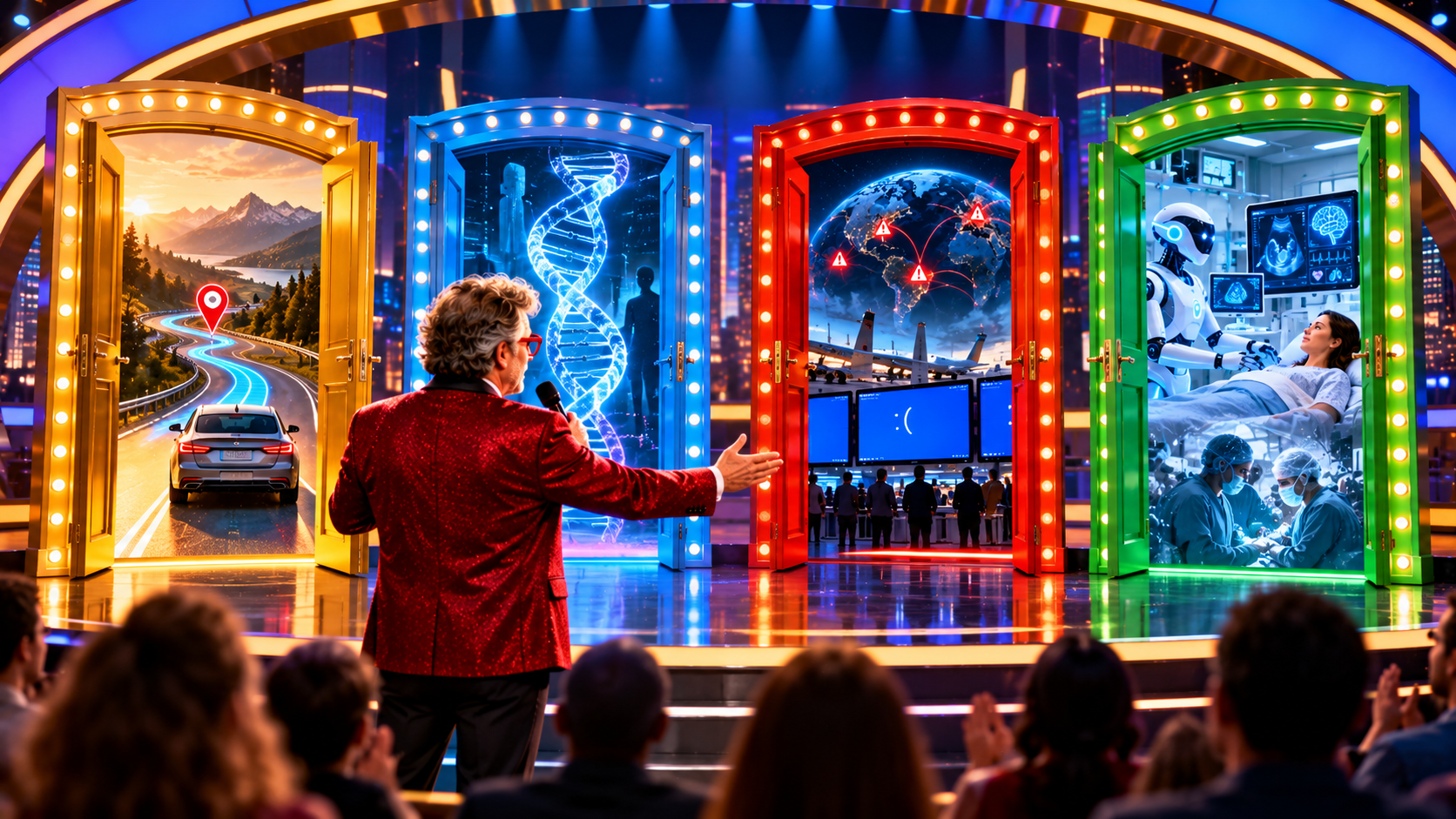
For thirty-five years, Bob Barker stood on the stage of The Price Is Right and presented contestants with an agonizing choice.

Behind Door Number 1: a new living room set, fully visible, clearly valuable.

Behind Door Number 2: a jet ski and trailer, right there on display, tangible and real.

Behind Door Number 3: mystery.

The contestant could see exactly what Doors 1 and 2 offered. But Door 3 was the unknown. It might contain a brand new car worth $30,000. It might contain a donkey wearing a sombrero. The only way to find out was to forfeit the prizes they could actually see.

And that mystery—that maddening, tantalizing unknown—became the essential ingredient that made the show work.

Continue reading… “The Maximum Curiosity Series: Why Curiosity and Truthfulness Will Define the Next Generation of AI”

The Permissionless Revolution: How HyperCycle’s Node Networks Prove Nobody Needs to Ask for Permission Anymore

By Futurist Thomas Frey

When Innovation Stopped Asking for Permission

In 2010, if you wanted to build a network infrastructure that would change how AI systems communicate globally, you’d need venture capital, regulatory approval, corporate partnerships, government permits, and probably a lawyer on retainer.

In 2025, you need a computer, an internet connection, and the audacity to just build it.

This is permissionless innovation, and it’s rewriting the rules of how transformative technology gets created. HyperCycle’s node network infrastructure—combined with tools like MosAIc Companion and experimental releases like HyperInsight—represents the perfect case study of this phenomenon. They’re not asking telecom companies for permission to build the Internet of AI. They’re not waiting for governments to approve their protocols. They’re not seeking validation from established tech giants.

They’re just building it. And anyone can participate.

This is what the future looks like.

Continue reading… “The Permissionless Revolution: How HyperCycle’s Node Networks Prove Nobody Needs to Ask for Permission Anymore”

The Invisible Sound Helmet: How We’ll Talk to AI Without Driving Everyone Crazy

By Futurist Thomas Frey

The Coffee Shop Problem

It’s 2028. Rachel Thompson sits in a busy Starbucks, working on her laptop. Around her, a dozen other people do the same. But the familiar quiet hum of typing and occasional whispered conversation has been replaced by something utterly maddening.

“Hey Gemini, pull up the Henderson contract from last Tuesday.”

“Claude, rewrite that paragraph to sound less aggressive.”

“ChatGPT, what’s the exchange rate for euros right now?”

“Alexa, remind me to call David at 3 PM.”

Every single person is talking. Out loud. To their AI assistants. Constantly.

Rachel tries to focus on her work, but the overlapping voices create an incomprehensible wall of noise. Someone three tables over is dictating an email. The woman next to her is having an argument with her AI about restaurant recommendations. A guy by the window is debugging code verbally, talking through each line.

After twenty minutes, Rachel gives up and leaves.

This is the future we’re hurtling toward—and it’s going to be absolutely unbearable.

Unless someone solves it.

Continue reading… “The Invisible Sound Helmet: How We’ll Talk to AI Without Driving Everyone Crazy”

Every Drive Becomes a Tour: How Geography-Overlay Apps Will Transform Self-Driving Cars Into Time Machines

By Futurist Thomas Frey

The Commute That Changed Everything

It’s Tuesday morning, 2031. Jennifer Mitchell climbs into her autonomous Tesla for the daily commute from Oakland to San Francisco. But instead of scrolling through email or zoning out to a podcast, she taps her phone and selects “1906 Earthquake Tour.”

The car’s audio system comes alive with the voice of a narrator as they cross the Bay Bridge.

“Just ahead, beneath these waters, lies the wreckage of the ferry terminal that collapsed during the quake. Over there—” the system highlights a point on her window with a subtle AR overlay “—that’s where the fire started that would burn for three days, consuming more of the city than the earthquake itself.”

As they enter the city, the overlay intensifies. Ghostly outlines of destroyed buildings appear on her screen, superimposed over the modern skyline. Historical photos fade in and out. Survivor testimonies play as they pass locations where people huddled in refugee camps.

Fifteen minutes later, Jennifer switches to “Tech History Tour.” Now the same streets tell a different story: the garage where Hewlett and Packard started their company, the hotel where Steve Jobs unveiled the iPhone, the coffee shop where Instagram was conceived.

Same geography. Infinite narratives.

This is the future of driving. Or rather, the future of being driven.

Continue reading… “Every Drive Becomes a Tour: How Geography-Overlay Apps Will Transform Self-Driving Cars Into Time Machines”

The Great Robot Rescue: When Good Intentions Met Hard Reality

By Futurist Thomas Frey

The Announcement

In January 2032, flanked by a gleaming white humanoid robot designated “Compass-1,” the Secretary of Housing and Urban Development announced what would become the most ambitious—and controversial—social program in American history.

“We’re not just housing the homeless,” she declared to cameras and reporters packed into the Capitol briefing room. “We’re giving them something better. We’re giving them hope. We’re giving them a partner.”

The Home Assistance and Navigation Directive—quickly nicknamed the HAND Program—would deploy 580,000 humanoid robots to every documented homeless person in America. One robot per person. Each unit cost $47,000 to manufacture, came equipped with AI decision-support systems, case management software, and the ability to navigate social services bureaucracies that defeated most social workers.

Total price tag: $27.3 billion, plus $4.1 billion annually for maintenance and cloud services.

“Think about it,” the Secretary continued, her hand resting on Compass-1’s shoulder. “These robots never get tired. Never burn out. Never give up on someone. They can work 24/7 to help our most vulnerable citizens navigate housing applications, job searches, medical care, addiction treatment. They can literally walk someone through every step of getting back on their feet.”

The bill passed Congress with rare bipartisan support. Conservatives liked the automation angle—fewer government workers, more efficiency. Progressives liked the scale—finally, resources proportional to the crisis. Technology companies loved it for obvious reasons.

By July 2032, deployment began.

Continue reading… “The Great Robot Rescue: When Good Intentions Met Hard Reality”
Discover the Hidden Patterns of Tomorrow with Futurist Thomas Frey
Unlock Your Potential, Ignite Your Success.

By delving into the futuring techniques of Futurist Thomas Frey, you’ll embark on an enlightening journey.

Learn More about this exciting program.